By Xi Cheng
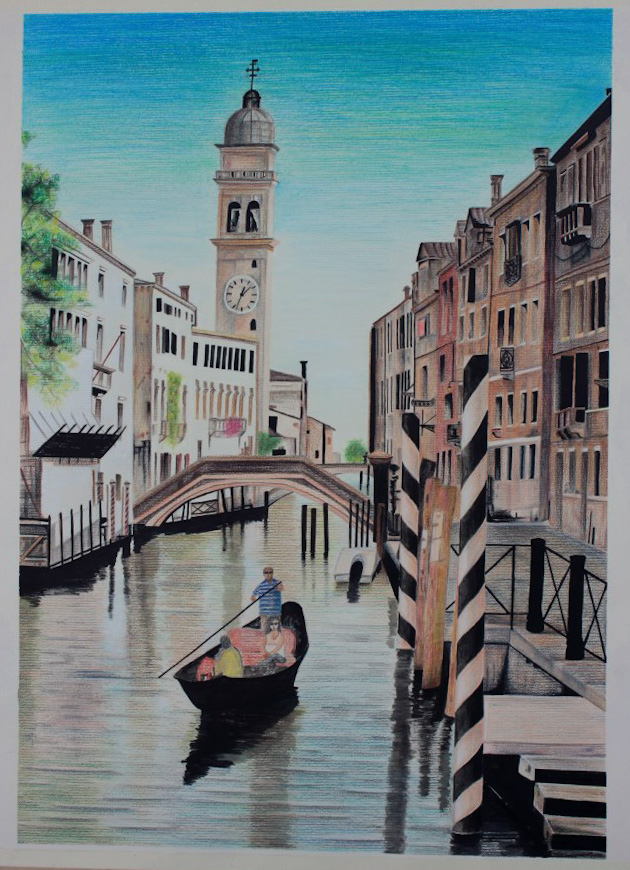


By Xi Cheng
By Hamilton Williams and Ami Regier
We playfully revised “The Lord’s Prayer” during a long night drive across the country. The spirit of Gordon Kaufman, author of In the Beginning, Creativity, came to our aid when we realized we could no longer utter the familiar prayer that speaks through medieval, feudal, patriarchal metaphors: lord, kingdom, father. We perceive creativity as well as the ideologies of time and place inhabiting the ancient words of the scriptural prayer. We imagine the ancient prayer is still unfinished. We hear other voices with their lists of deliverances through time. We hope others will offer infinite and contesting revisions, reflecting their perspectives and language. We know our voice in this poem escalates here and there with our ideological issues of the millennial moment. We hear in the occasionally wrenched cadence much ongoing wrestling with religious inheritances. We hope for cross-cultural religious intersections. We imagine a reverse occupation, whereby the religious tradition that occupied indigenous religious spaces could be in turn re-occupied, in the spirit of the Occupy movement, of course! We share a tendency to experience religious language as struggle and transformation. Gordon Kaufman recommended addressing divinity as a non-anthropomorphic construct, Creativity:
Our Creativity, which stretches throughout the universe,
Hallowed be thy energies.
Thy challenges come, as true human beings we become
Changed by the garden, and changed by the sky.
Mutate us this day our daily being.
Forgive us for climate change, as we forgive those one-percenters who duped us, those trespassers.
Forgive us our blindnesses.
Transform our biases — for example, the blindness of whiteness.
Lead us away from capitalism and into social embraces.
Deliver us from individualism and cultural stagnation.
Guide us away from GMO biological manipulation, to respect culture and food sovereignty.
Protect us from privatization and its refusal of public good.
Bring us the grace of earth and heaven, as we restore the indigenous values of your being.
For creativity has the power and glory to transform us, forever and ever.
By Martin Olson
September is Octobering,
and you and I can’t hide from the wind.
I heard it was getting colder, but I never thought that it was true.
The rustling curtains, the papers blowing off the desk,
the doors that slam.
We had an uninvited guest, I thought.
It was you, I thought.
But no,
September is Octobering,
and our windows are not closed.
You and I can’t keep out the wind like this.
It’s just a matter of time till it gets in.
It’s just the wind, isn’t it?
You and I have nothing to worry about.
Well, nothing except for the wind.
September is Octobering, and
sometimes at night I wake up chilly,
with dew drops formed on the peak of my nose, and
balanced on my eyes, and
they slide across my face when I get up, and
it looks like I’ve been crying, but
it’s just because of the wind.
Nothing is the matter, and I
‘m not even cold.
September is Octobering,
and it’s just the wind, and
if your papers get thrown to the ground, and
if we both get chills in the night, and
if the door slams behind me, and
if we stay up all night, it’s
the wind.
Just the wind.
September is Octobering,
and things are alright.
By Martin Olson
It is sobering, after a summer day in winter,
to become like ice in the world, and to feel it even inside.
I know these things now the wind’s changed.
I just get stuck, used to it, when the warmth comes around,
and these days of summer––peppering us with hope in the face
of the blizzard––lie.
You lie next to me, and I to you,
because my hand drags along the page after the pen,
smearing these words as soon as I write them.
As I drift into winter, I see the sun dying again,
taking back its warmth, but I don’t think I’ll miss it;
now I don’t need it quite so much.
Things don’t break apart, and they don’t decay.
They just get colder and stop moving,
so we kindle fires and keep alive,
but sometimes I just don’t want to.
Your summer is longer than mine,
or rather you have more than one,
and you never want summer to end.
I used to want another summer…
but now I think that winter’s fine.
No more lies, and
No more summer days.
I can live on canned beans and soft potatoes,
and I don’t use my fingers anymore, so if they
fall off in the frost, that’s fine.
All paper is brown, and crumbling even in vestigial sun––
particles drift to the ground, lackadaisical
––but I won’t anymore.
Summer is a lie come winter
and I don’t need to lie down.
Por Nicole Eitzen
Quisiera estrechar la mano para alcanzar aquello
que frente a mí se desvela,
aquello que mi corazón desea y que a mi alma enternece.
Quisiera ser aquello que sólo mis sueños contemplan;
no una, sino dos: la que se libra y la que permanece.
Es que el querer y desear lo imposible
en mí se viven constantes:
No voy a renunciar a instruirme, voy a mi misma elevarme.
Pero dejar el amor, me dicen, resulta en falsos pasos dictantes.
La vida sin él es posible, pero amar sin él: para nadie.
¡Y paso las noches en vela, por él y su mundo velando!
Por noches de un mundo de encanto que frente a mi se desvela.
¡Y como decirle quisiera, que a su querer le tenga cuidado!
Porque cuando el alma dulce enternece,
el suave roce: desvanece.
By Cody Claassen
The Old Forest reaches from top to toe,
And through this woods we all must go.
Let evil be vanquished with each kill we sow,
What the Children learned then, the Elders now know
“Wilric, what is the most important thing to remember during The Great Hunt?” Teacher asked. Wilric jolted awake from where he sat in the clearing, lit with the dying sun and the content flames of the fire in the middle of the circle of children. He saw a disappointed look from the retired Forest Guard. Snickers from the other Leaf Scouts tittered from his left and right side.”I’m sorry, Teacher, I didn’t hear the question. What was it again?”
The scarred teacher sighed. “During The Great Hunt, what should you do?”
“Ummm… You should chew on willow bark?” said Wilric, his tone jovial.
“No, Wilric,” the teacher chided. “That’s for mild pain. Can anybody else remember?” Many other hands shot up from the other children gathered in the clearing. Murmurs and pleas for selection arose from the young students. “Marten, what is the answer?”
“During the Great Hunt everyone should stay indoors, lock all doors, and open them only after the sun has risen again, always keep something made of iron on your person or close by, and keep a fire made of rowan burning hot in the hearth,” said Marten with no hesitation or pause.
“Very good, Marten.” said the teacher, scarred from age and combat with a smile, pride briefly touching his one good eye. “And if you are caught outside?”
Marten paused before speaking. “I don’t know. I suppose I would want to seek shelter anywhere I could.”
“Hmm, that’s part of it, definitely seek shelter: find the safest place you can find. But the most important thing during the Great Hunt is to be mindful. Be mindful of your surroundings, be mindful of the time, and most importantly, be mindful of the horns,” the teacher said grimly.
“Well,” said Wilric. “I think we should also look out for antlers and tusks and all manner of pointy things.”
The teacher’s face changed into a gnarled mass of anger, but only for a second. “No, Wilric,” he said in a restrained voice. “By horns, I mean bugles and trumpets. Horns that would be used in a hunting party. If you are outside during the Great Hunt and can hear the horns, find the direction it is loudest and then go the opposite way. If the horns end suddenly, you’re already dead. Find shelter, do not build a fire, and do not draw your weapons. That will only enrage her.”
By Kaitlin Schmidt
She wrote of her father’s family, which she met only in dreams. The fabrication of details didn’t upset her conscience because the doctor gave her license to ‘create’ whatever she thought would contribute to healing. Claire created and recreated, things from her mind and life and things from an imagined life she might have lived once.
Instead of unpacking the boxes that formed cardboard towers all around her childhood bedroom, she rummaged in her old desk for paper. Her palms became coated in soft gray dust while she investigated the empty cubbies and drawers. She had been gone long enough for these spaces to be unfamiliar now. Out the window and up the street – the lawns and houses were only the bones of her memories, while all the flesh and color had changed.
She found a yellow legal pad with scribbles about a missed phone call on the top page. She ripped it off and started fresh.
The facts were never nailed down, the youngest sister craved answers but they floated between her fingers like mist, only moistening her palms. She listened to her mother speak of family photographs.
“Some folks in everyday clothes and alongside them full Indians with feathers and beads all the way down.”
They were relatives, she said. The people in the photos were the great aunts and uncles that had left the reservations for a different sort of living and then came back to visit. These photos, though much discussed, could never be produced when relatives were called upon to search them out from top-shelf closet boxes and from basement storage bins.
By Megan Siebert
Out to Sand Creek. Campus abandoned
Students trek for singing and fires
By academics and studies orphaned
Young adults their social lessons acquire
They can hear the bottles sipped on
Warm Fridays recall laughter, shouting
Twigs and brambles freely tripped on
I can’t see anything, battle cry of the outing
Smoke fills their eyes, their cups and clothes
Darkness clouds as new hands meet
Bluegrass rests for the profane, swear-filled toast
And cheerfulness fills as hearts and fire heat
At end of night, they bear welcome pressures
Drinkers and dreamers morph to Threshers
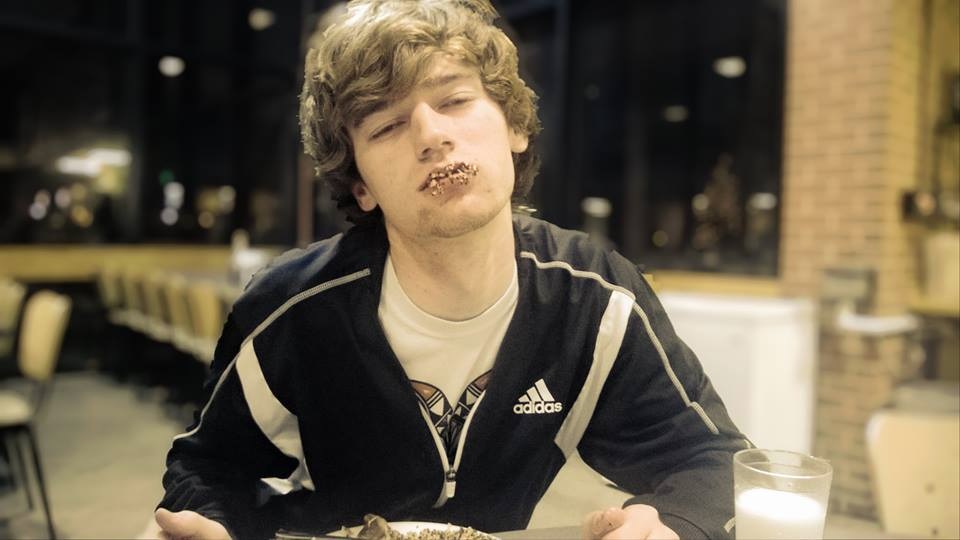
By Mareike Bergen (Model: Matt Rodenberg)
By Kaitlin Schmidt
When I nap in the afternoon, on top of the sheets,
I imagine the tingling ghost of something
in the space between my palm and fingers.
I imagine the weight of a hand on my hand.
I like to pretend you apologize to me in languages I can’t read –
“I’m sorry” says the glossy painting in the Chinese restaurant.
“How very careless I am” say the Spanish subtitles.
I imagine that the sparrow who studies me while I work,
who creeps and fidgets, pauses and peers,
houses the diamonds of your condensed soul in its chest.
It bounces here and there; you rattle and shine.
Tipsy and light on melancholy chords, I drink my illusions by the gallon.
I toss them up like confetti and all things ordinary blur as you flutter down.
 bclines.bethelks.edu